


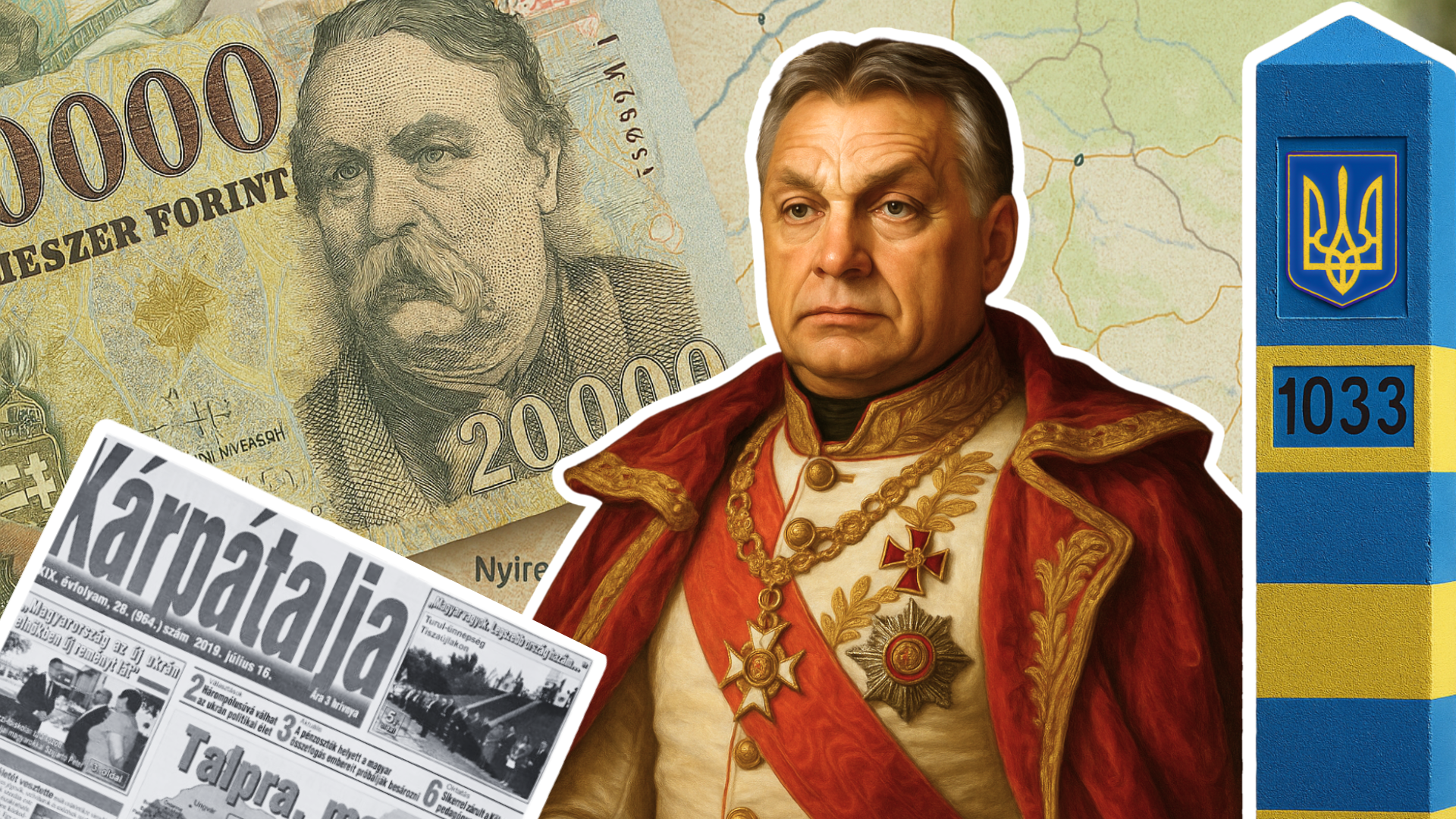
For the first time, Ukraine’s security services have uncovered an active network of Hungarian military intelligence agents operating in Zakarpattia, a western region with a large ethnic Hungarian population. It’s likely that Budapest may be quietly preparing for future territorial claims or intervention under the guise of protecting ethnic minorities, the same type of tactics that Russia likes to use.
That’s not the only thing Viktor Orbán appears to have borrowed from Moscow. He has increasingly mirrored Vladimir Putin’s model of power, entrenching his rule, stealing everything that he can, and ensuring that a loyal inner circle maintains control over the country.
The Robert Lansing Institute noted that while Hungary lacks the capacity for a full-scale invasion, its forces have made plans to carry out limited operations under a “peacekeeping” pretext, potentially with Moscow’s support. This would heavily depend on if Russia was successful in defeating Ukraine on the battlefield. It is likely that Hungary’s intelligence activities may overlap with Russia’s, as both countries share revisionist goals in Ukraine.
The Financial Times quoted one analyst who highlighted that “Hungarians have aimed for this for years: Ukraine falling apart as part of a Russian strategy,” hoping that Moscow would reward them with territorial gains.
One pro-Orbán propaganda account, followed by Hungary’s defense minister, went viral with a video fantasizing about a Hungarian military occupation of Western Ukraine, captioned: “Operation Turul Coming Soon....” In a recently leaked audio, the defense minister said Hungary's army is being reshaped “to break with the peace mentality and move toward phase zero of the road leading to war.”
Joseph Place, an academic from the UK who currently lives in the Zakarpattia region, stated, “Orbán has often been convinced that Zakarpattians feel oppressed and dream of being Hungarian again. However, Hungary’s response to the invasion alienated much of the Hungarian-speaking population, many of whom now identify more strongly as Ukrainian.”
He added, “Orbán, presumably with Putin’s blessing, wants to take the region back, seemingly for a combination of nationalism, nostalgia for Trianon, and a dose of good old-fashioned Russophilia.” Similar sentiments have long existed regarding Romania’s Transylvania, home to a sizable ethnic Hungarian population, which is estimated 1.2 million people.
László Zubánics, a history professor and the head of the Hungarian Democratic Federation in Ukraine stated that there were around “300-400 ethnic Hungarians currently fighting on the frontlines” in December 2023.
But Hungary’s ambitions are not limited to its eastern neighbor. Szabolcs Panyi, a Hungarian investigative journalist, pointed out that Hungary’s broader ambitions appear focused more on the Balkans than Ukraine. “There’s lots of noise, domestic political battles around the topic, and it’s unclear what the Hungarian public can understand from it,” he said.
“The more worrying news and information are about Orbán’s meddling in Bosnia, selling BTR infantry vehicles to Serbia, plus the recent deployment of special police forces to Banja Luka to extract Milorad Dodik in a ‘worst case scenario.’ There are many theories swirling around, but Orbán’s focus on the Balkans is much more obvious.”
Panyi also pushed back on the idea of an imminent Hungarian military intervention in Ukraine. “There’s a theory, or conspiracy theory, that in case Russia occupied Kyiv and Ukraine quickly after the invasion started in February 2022, Hungary would have sent peacekeeping or occupying forces into Western Ukraine. But even that scenario was about an already defeated Ukraine, where Hungary wouldn’t have been involved in direct fighting.”
In practical terms, he said, such an operation would be nearly impossible. “As far as we know, Hungary’s army is fully unprepared for any type of conflict with anyone. Ukraine’s army is so superior that it’s completely unrealistic that Orbán would engage in direct fighting.”
Panyi added that the scandal is already damaging Hungary’s credibility. “This spy saga hurts Hungary’s standing within the EU for sure, especially that it could further undermine Hungary’s credibility and lead to more second-guessing whenever Hungary is trying to hinder EU support for Ukraine.
“When it comes to Hungarian–Ukrainian relations, Ukraine’s abilities to escalate and retaliate are also far superior, from a Hungarian diaspora living in Ukraine to gas and oil transits going through the country. I don’t see how Hungary could ‘win’ such a situation,” said Panyi.
These developments are part of a broader pattern in Orbán’s defiance of the European project. Orbán has repeatedly used his veto power to block EU decisions, including delaying aid to Ukraine and threatening to halt Ukraine’s EU accession, which he claims would “bankrupt Europe.” Following revelations about Hungary’s intelligence operations in Ukraine, Orbán accused Ukraine’s special services of trying to disrupt a public survey of Hungarian citizens on Ukraine’s bid to join the European Union.
Meanwhile, Orbán’s government relaunched a national poster campaign targeting EU leaders Ursula von der Leyen, Manfred Weber, and Ukrainian President Volodymyr Zelensky, using taxpayer money to portray them with red “X” marks to push Hungarians to shape public opinion against them. This is part of Budapest’s effort to vilify Ukrainians and rally Hungarian support for Orbán’s dream of conquering western Ukraine, or a minimum, justify his continued pivot to the East. Beijing and Moscow have no issue with Orbán looting the country and turning Hungary into the EU’s most corrupt state.
At the same time, Hungary’s foreign alignments are drifting further from the West. While Orbán has long positioned himself as Europe’s leading nationalist conservative voice, Hungary’s deepening ties with China are likely to further undercut Orban’s standing. Budapest has become a hub for Chinese influence in Europe, hosting joint technology ventures and even allowing Chinese police patrols on Hungarian streets. Budapest also recently enacted a visa scheme easing entry for Russians and Belarusians, opening loopholes for espionage and threatening the integrity of the Schengen area.
Facing economic troubles and growing political opposition at home, Orbán is betting heavily on Chinese investment to fuel his reelection campaign. Hungary is now more ideologically aligned with China than with much of the rest of Europe and China has become Hungary’s largest foreign investor.
He was hopeful that Trump’s election would’ve allowed Russia to be reintegrated into the rest of Europe. Instead, Orbán’s idol in Moscow is openly ignoring Trump’s demands for peace and is undergoing preparing for a larger offensive in Ukraine.
“One of Washington’s long-standing goals was to prevent China from aligning too closely with Russia. Yet we now see the opposite: China growing bolder, Russia acting with impunity, and the West struggling to present a united front,” said Oleksandra Ustinova, a Ukrainian member of parliament. Meanwhile, China is building a foothold in the heart of Europe, right under the nose of Trump’s administration. Hungary is now a hub for Chinese and Russian spies.
The top U.S. envoy to Hungary recently warned Budapest about the risks of deepening ties with China, signaling a potential strain in Orbán's otherwise close relationship with Donald Trump. Despite his best efforts to attract major Chinese investments – capturing 44% of China’s invest – Trump’s hardline stance against China could create friction. Meanwhile, Hungary’s economy minister said the country won’t scale back ties with China, rejecting U.S. pressure to distance itself from Beijing.
Domestically, Orbán now faces his most serious political threat in over a decade. Péter Magyar is emerging as the strongest challenger Orbán has faced in 15 years. His TISZA party has surged to a 14-point lead over the ruling Fidesz party, according to the 21 Research Center – putting it within reach of a two-thirds parliamentary majority ahead of the 2026 election.
Orbán’s imperial ambitions, recently exposed in Ukraine, proved to be a significant embarrassment. Panyi warned, “Viktor Orbán is spinning it as a Ukrainian intel plot tied to the TISZA opposition party. The narrative is clear: frame the opposition as foreign agents, and justify an impending crackdown.”
The reality is that Orbán and his inner circle have spent years hollowing out Hungary’s institutions for personal and political gain. With his grip on power showing signs of weakening, Orbán may see war, or the state of emergency it creates, as a pathway to martial law and political survival ahead of a potential electoral defeat.
However, if Orbán were to follow Putin’s path and attempt an incursion into Ukraine, his army would crumble against Ukrainian forces, bringing about the swift collapse of his rule. One would think he’d learn from Putin’s mistakes.
About Author:
