Tennis is an exceptionally popular sport among the Ukrainian diaspora in the United States. This is confirmed by the annual championships regularly held by the Ukrainian Sports Federation of the USA and Canada (USCAK). In 1987, the 32nd tournament took place. This is truly a remarkable story that deserves to be told separately. That year, the tennis competition was unique for several reasons. First, it featured a rich arts program that impressed audiences with its vibrant character and Ukrainian traditions. Second, the competitors included many prominent tennis players, as well as future international tennis star Greg Rusedski and his brother, Vasyl Rusedski, who would later become a distinctive artist.
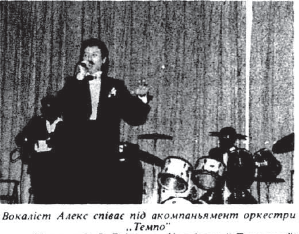
This tournament was no ordinary event on the American sporting calendar. The competition was thoroughly imbued with the Ukrainian spirit and Ukrainian traditions. The tennis and swimming championships were organized by the Ukrainian Sports Federation of the USA and Canada. Athletes of Ukrainian descent took part in the competitions, while the extensive cultural program featured performances by Bohdan Hirniak’s orchestra; the Dva Kolory orchestra; vocalist Alex, who sang Ukrainian folk and contemporary songs, including works by Volodymyr Ivasiuk; Yurii Hrab with the Tempo orchestra; the Yasmin women’s choir; and Ania Hramiuk, a Ukrainian bandura player from Poland. And that was not all!
The Arts Program on the Eve of the Tennis Tournament
The Ukrainian press in the United States described the significance of the arts and cultural program held ahead of the USCAK sports competitions as follows: “With warm drops of rain and the nearly autumnal colors of the trees reflected in the waters of the Catskill Mountains, Soyuzivka bid farewell to its guests on Monday afternoon, September 7, having earlier rewarded them with sunny, though cool, weather, excellent arts programs, spirited athletic competitions, and lively dances accompanied by outstanding orchestras. As in previous years, young people from every corner of the United States and Canada seemed to have conspired to take over the Ukrainian National Association resort during this Labor Day long weekend. As early as Friday, September 4, the number of guests at Soyuzivka began to grow with the arrival of young people who, apparently not having seen one another for a long time, embraced, kissed, and then celebrated, sang, and danced.”

Such was the tremendous euphoria among the participants in the cultural and athletic program. Ukrainians have always known how to combine sports with art, culture, and history in a skillful and spectacular way in order to preserve their long-standing national traditions.
Beginning on Friday, vibrant artistic entertainment and performances took place every day: “On Friday evening, the first of three dances was held on the Veselka terrace to the music of Bohdan Hirniak’s orchestra. Throughout Saturday, guests watched the tennis and swimming competitions, while in the evening they were entertained with Ukrainian songs by the vocalist Alex. In the first part of his program, he sang new songs from Ukraine to the accompaniment of the orchestra with which he had recorded his latest album. The accompaniment was played from a recording. In the second part of the program, Alex performed with the Tempo orchestra, entertaining guests mainly with songs by V. Ivasiuk… On Sunday, the tennis competitions continued on all of Soyuzivka’s courts, although under cloudy skies. That evening, a 25-member women’s choir from Mississauga, Ontario, conducted by Khrystyna Harasovska-Shevchuk, appeared on the Soyuzivka stage for the first time. This charming and vocally well-balanced ensemble performed a number of popular Ukrainian songs in a lighter style.”
It was an incredible three days of Ukrainian art, creativity, and music combined with athletic competitions.
It should be noted that this was not the full extent of the artistic program. A genuine surprise for the Ukrainian community in the United States was the arrival and performance of a renowned Ukrainian bandura player from Poland. The press wrote: “During the intermission, the bandura player Ania Hramiuk, a visiting Ukrainian from Poland, performed. She had studied the bandura in Kyiv under the celebrated virtuoso Serhii Bashtan. She performed five folk songs and compositions.”
Can you imagine the geographical range of participants in these Ukrainian artistic and athletic events—from the United States, Canada, Poland, and Australia?
The artistic events preceding the tennis tournament and swimming competitions were attended by distinguished and honored guests, including members of the Supreme Assembly of the Ukrainian National Association and editors of its publications: Supreme President Dr. Ivan Flis; Supreme Advisors Volodymyr Kvas and Adik Khudolii; honorary members Maria Dushnyk and Anna Haras; Soyuzivka manager Dork Senchyshyn; Zenon Snylyk, editor-in-chief of the newspaper Svoboda; Roma Hadzewycz, editor of The Ukrainian Weekly; federal judge Dr. Bohdan Futey; Miss Soyuzivka Hania Klym; and many other dignitaries.
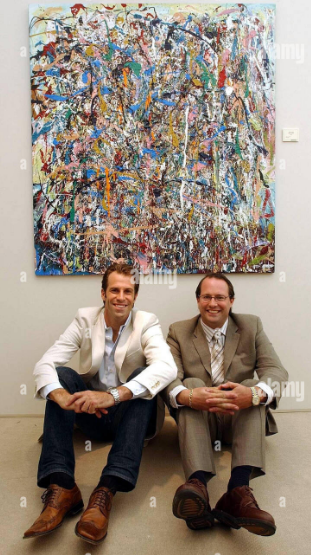
I assume that this remarkable arts program may have influenced Vasyl Rusedski’s later choice of career. Like his younger brother Hryhorii, or Greg, he played tennis, but went on to build a successful career as the creator of distinctive paintings.
The 32nd USCAK Tennis Championship
The 32nd men’s and women’s tennis championship held under the auspices of the Ukrainian Sports Federation of the USA and Canada took place on September 5–7, 1987, at the athletic facilities of the Ukrainian National Association’s Soyuzivka resort. It was an outstanding tournament featuring stars of Ukrainian tennis from the United States and Canada. Of course, it could hardly have been otherwise. But this time, another star emerged on the tennis courts—Hryhorii Rusedski.
Greg Rusedski is an exceptionally well-known and successful Canadian and British tennis player. He was born in Canada and later represented Great Britain—and he is also of Ukrainian descent. His parents are Ukrainian. The newspaper Ukrainskyi Holos wrote: “Hryhorii is the son of Anatolii and Halyna, née Sokyrko, Rusetsky. The family belongs to the congregation of St. Sophia Cathedral in Montreal, where his grandfather Vasyl Rusetsky served as senior brother. His parents belonged to the Ukrainian Youth Association, which Hryhorii’s older brother Vasyl also joined.”
Unfortunately, Greg Rusedski’s Ukrainian roots are not mentioned very often. Even the renowned Wikipedia does not have a Ukrainian-language page about Greg Rusedski. And the biography section of his own website presents the matter rather confusingly: “Greg Rusedski was born on September 6, 1973, in Montreal, Canada. His father is German of Russian-Ukrainian descent, and his mother is English. Greg is the younger of two brothers, both of whom played tennis at a high level from an early age and aspired to become professional players.” From this description, we learn that his father was German with Russian-Ukrainian roots. Indeed, I myself did not initially understand this entire family background. However, other sources, including those I have already cited, state otherwise. Greg Rusedski does, in fact, have Ukrainian roots. Both his father and his mother are of Ukrainian descent.
Today, when Russian terrorists have been killing Ukrainians for twelve years and have spent centuries trying to distort and falsify the history of the Ukrainian people, we must correct the record and reclaim our true Ukrainian sporting history.
We learn that Greg’s path in tennis was not easy: “Their parents could afford to finance the dream of only one of their sons, so the decision was made that Greg would be the son they supported; it was believed that, of the two, he would cope better with the pressure. Further sacrifices had to be made: Greg’s parents refinanced their home three times so that he could travel and compete in junior tournaments.”
Many Ukrainians abroad faced a similar fate. In their memoirs, athletes who are now famous recall how their families lacked the money needed for them to pursue the sports they loved. At the same time, they all noted that their parents’ support and their Ukrainian character gave them the strength to fight and continue moving toward their dreams. Sports experts in the United States and Canada have confirmed this, saying that Ukrainians are exceptionally strong both genetically and mentally.
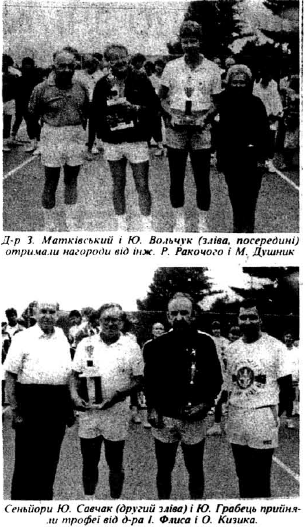
The tennis competition generated tremendous excitement among participants, spectators, and guests. The tournament was organized and supported by USCAK, the Carpathian Ski Club, the Ukrainian National Association, and the Mazepa Foundation. Traditionally, cash prizes for the winners were provided by the Tennis Development and Promotion Fund of the Mazepa Foundation. The Fund’s principal benefactor is Ivan Hyniansky, a prominent Ukrainian businessman in the United States, philanthropist, and charitable donor who, incidentally, is himself fond of sports, particularly tennis. Other awards were presented as follows: “The Ukrainian National Association awards were presented to the finalists by Supreme President Dr. Ivan Flis, Supreme Advisor Volodymyr Kvas, honorary member of the Supreme Assembly Maria Dushnyk, USCAK representative Omelian Twardowsky, Soyuzivka manager Dorko Senchyshyn, Carpathian Ski Club vice president Orest Kyzik, a guest from distant Australia and former distinguished athlete Omelian Buchatsky, and members of the tournament committee: engineer Roman Rakotchy Sr., Yu. Savchak, and Z. Snylyk.”
Although Greg and Vasyl did not win the tournament in their respective age groups, the experience was exceptionally important in the later lives and careers of both brothers. The press wrote the following about Hryhorii Rusedski: “Making his debut in the men’s division was 13-year-old Hryhorii Rusetsky of Montreal, Canada, an exceptionally talented young player who is ranked No. 1 in Canada among boys aged 14 and under.” Greg Rusedski arrived in the United States already regarded as one of Canada’s best young tennis players. In the United States, Greg made his debut in the men’s division, where he faced strong opponents. Unfortunately, he lost in the second round to Ihor Kupchynsky, 1–6, 7–6 (10–8), 2–6. This defeat did not discourage the young Hryhorii. On the contrary, it motivated him to become even better. It should be noted that at the age of thirteen, Hryhorii was competing against older opponents, which gave them a certain advantage. At the same time, it provided him with highly valuable experience. Vasyl Rusedski competed in the boys’ under-18 division. In the semifinal, he lost 1–6, 0–6 to the eventual tournament winner, Andrii Haidukevych.
Dr. Ihor Kutash recalled Hryhorii Rusedski’s early years as follows: “Hryhorii had loved sports since childhood. And this was not the first time he had achieved notable success in tennis. Three times over a period of two years, he took first place in all of Canada in the division for competitors aged 14 and under. Since then, Hryts has grown to six feet three inches. As the young athlete explains, this forced him to change his strategy of play.”
Thus, the trip to the United States and participation in the USCAK tennis championship had a powerful influence on the young Hryts. As he grew older, he reconsidered his style of play. In the following years, this led to an extraordinary flowering of Hryhorii’s talent and skill.
Three years later, in 1990, 16-year-old Hryhorii astonished well-known and experienced tennis players with his ability: “On Sunday, March 4, an upset occurred during Quebec’s Mirabel Indoor Tennis Classic. Sixteen-year-old Pointe-Claire resident Hryhorii Rusetsky defeated the experienced Stéphane Bonne of Trois-Rivières and took first place. In doing so, the young player, who until then had been ranked 42nd in all of Canada, once again attracted the attention of the Canadian sporting world.”
Hryhorii defeated the more experienced 20-year-old tennis player by combining powerful and rapid movement with equally powerful and rapid ball striking—all with his left hand. Stéphane Bonne was astonished by Hryhorii’s transformation: “This is not the same Hryhorii Rusetsky I played before!”
At the age of just 17, Greg Rusedski, partnering Morocco’s Karim Alami, won the boys’ doubles title at the 1991 Wimbledon Championships. Incidentally, in the final, the Rusedski–Alami pair defeated a team that included Ukrainian tennis player Andrii Medvediev. Greg Rusedski’s career continued to develop, and he earned a reputation as an exceptionally accomplished tennis player.
Author: Oleksiy Lyakh-Porodko