


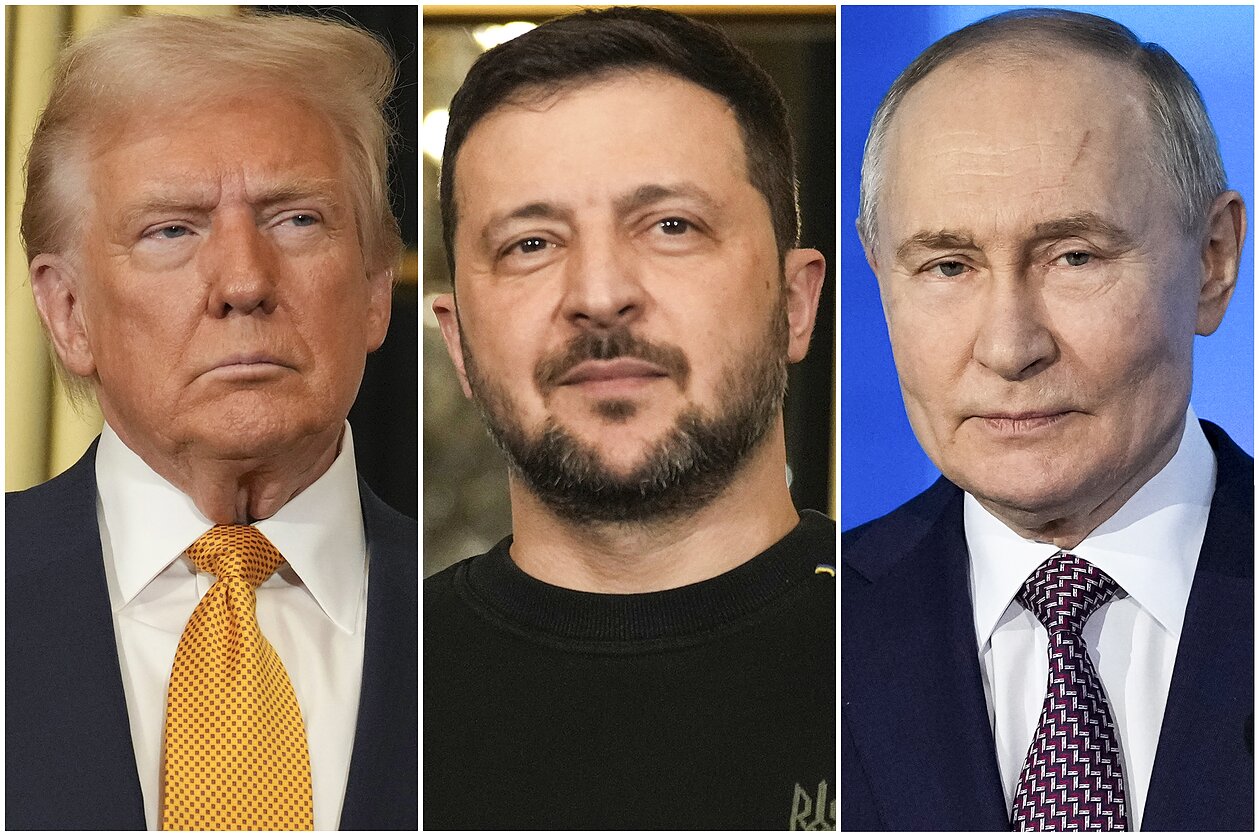
 The events of the war in Ukraine have once again become the reason for a number of statements by international leaders. Ukrainian President Volodymyr Zelensky has emphasized the crucial role of American aid, while disputes over the current administration's policy continue in the United States. Against this background, the future of the global security system is also being actively discussed.
The United States is providing Ukraine with opportunities to strike deep into Russia
The US Ambassador to NATO, Matthew Whitaker, said that Washington is significantly expanding its support for Ukraine, in particular by providing "opportunities" for deeper strikes on Russian territory.
In an interview with Fox News he emphasized that in the last month alone, Ukrainian forces have been able to disable about 20% of Russia's oil refining capacity. According to him, in addition to direct arms supplies worth about $1 billion, the United States is coordinating supplies through NATO allies for about the same amount every month. Whitaker stressed that Donald Trump's policy differs from the approaches of the previous administration of Joe Biden, because American taxpayers do not directly finance these supplies.
Whitaker also said that Trump seeks to maintain a balance between military aid to Ukraine and political dialogue with the Kremlin.
"Will it happen overnight? Most likely not. But I think we are moving in the right direction, and both sides are still in dialogue, and that is already good," the ambassador emphasized.
It is the combination of military support and diplomacy, according to Whitaker, that is key to the current US strategy.
The Kremlin accused Europe of hindering Trump's peace efforts
Russia stated, that it is European countries that are allegedly preventing US President Donald Trump from making progress in a peaceful settlement of the war in Ukraine. Press Secretary Dmitry Peskov called them part of the "war party" and stressed that Moscow is ready to resolve the issue by political and diplomatic methods, but allegedly does not see any readiness on the part of Kyiv. The statement emphasized that the "special operation" will continue until Russia receives signals about Ukraine's genuine interest in peace. Thus, the Kremlin is trying to shift responsibility for the escalation to the West.
At the same time, European countries express doubts about the sincerity of Vladimir Putin's intentions. EU leaders recall that Moscow has repeatedly declared its readiness for negotiations, but refused to make concessions, in particular regarding the occupied territories. Against this background, Russian Defense Minister Andrei Belousov said that the Russian army has increased the pace of the offensive and is now capturing 600-700 sq. km per month. Official US data show that more than 1.2 million people were killed and wounded during the war, and Russia currently controls about a fifth of Ukraine's territory.
Trump: There will be no US troops in Ukraine, but aid to Europe continues
US President Donald Trump emphasized in a comment to the Daily Caller that the United States does not plan to send its own troops to Ukraine. At the same time, he acknowledged that certain security guarantees are necessary to end the war. According to him, American assistance will focus on supporting European countries, in particular in the area of airspace control.
"We will not have troops on the ground. But we will be able to help Europe," Trump said.
The president emphasized that this could involve periodic air patrols, which will be carried out mostly by European allies, while the US will help with equipment and coordination. He also emphasized that the current policy does not involve spending from the pockets of American taxpayers.
"We sell NATO equipment. We do not sell it to Ukraine. We sell it to NATO. They pay for the equipment. We don’t spend any money on war,” he added.
According to Trump, such approaches allow the United States to avoid direct involvement in hostilities, while remaining an important factor in the settlement process.
US President doubts direct talks between Putin and Zelensky
In an interview with the Daily Caller Donald Trump said that direct talks between Vladimir Putin and Volodymyr Zelensky are unlikely in the near future. Instead, he hinted at the possibility of a trilateral format with himself as a moderator.
“A trilateral format is possible. Bilateral - I don’t know, but a trilateral one will happen,” he said.
According to the US President, sometimes conflicts “have to go on for a while before they can be stopped,” but he does not reject his role in mediation attempts.
Ukrainian President Volodymyr Zelensky, meanwhile, has expressed dissatisfaction with Moscow’s delaying of the negotiation process by avoiding high-level meetings.
Amid these diplomatic efforts, hostilities have only intensified: Russian troops have announced new gains in the Dnipro region, while Ukrainian authorities have reported civilian casualties in Zaporizhia.
Russian Trace: Murder of Andriy Parubiy in Lviv
On August 30, former Speaker of the Verkhovna Rada of Ukraine Andriy Parubiy was murdered in Lviv. According to Ukrainian media According the shooting took place in the afternoon on Yefremov Street, where an unknown assailant dressed as a courier opened fire with a firearm. Seven shell casings were found at the crime scene, and witnesses reported that the man had a food delivery bag, which could have helped him disguise himself. The victim died from his injuries before the arrival of medics, and the police immediately began investigating.
President Volodymyr Zelenskyy promptly received a report from law enforcement officers and stated that all necessary forces had been deployed to search for the attacker. The event caused a significant resonance in society, as Parubiy remained a well-known figure in Ukrainian politics and public life. Investigative teams are still working at the scene of the tragedy, clarifying the details and possible motives for the crime.
The murder of Parubiy became one of the most high-profile crimes in Lviv in recent times, raising many questions about the safety of political figures even in relatively calm regions of the country in the face of a full-scale war.
Author: Danylo Pievchev